
Goodenough Bay (1884-1886), Disaster Bay (1896- 1902), Cygnet Bay (1905-1910)
In the pearling belt on the east coast of Dampier peninsula the mission effort proceeded in stops and starts. The mission efforts along this coast were never German-run, but form part of the Kimberley mission history, with Fr. Duncan McNab at Goodenough Bay (1884-1886), the French Trappists at Disaster Bay (1890, 1896-1904) Fr. Nicholas Emo at Cygnet Bay (1905-1910), and the private ‘mission’ at Sunday Island (1899-1923). The Trappists used Disaster Bay as an outrigger station of Beagle Bay. All of these efforts grafted on to the Latino/Aboriginal communities along the coast including Thomas Puertollano.
Beagle Bay (1890-2000)
Beagle Bay in the Kimberley commenced as a French Trappist mission in 1890, and was taken on by the German Pallottines in 1901. It became the centre of the Pallottine expansion into the Kimberley and beyond.
Zach, Rudolf Br (1870-1928)
Born in Berngau, 1 February 1870
Died Limburg 7 September 1928, age 58
Pallottine at Beagle Bay Mission from 1902 to 1914 first as cook, then as carter and chicken and pig keeper, also the organist and choirmaster. Acted as grave-digger and had a preoccupation with death, and encountered the ghost of a recently departed mission girl.
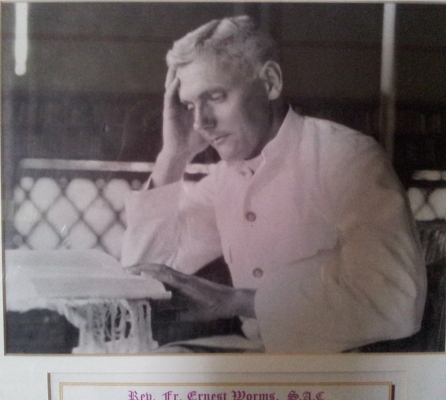
Worms, Ernst Alfred Fr (1891-1963)
born 27 August 1891 Bochum
died13 August 1963 Sydney, age 72
One of the first mission anthropologists and the first Pallottine in Australia to gain wide recognition for his work on Australian religion and rock art in the north-west. Worms published profusely on Aboriginal lifeworlds from 1938 until his death, and his second major book was newly released in 2006.
|
|
| A portrait of Father Worms held in the Pallottine Centre, Sydney. |
Wollseifer, Matthias Br (1879-1952)
Born 19 March 1897, Frechen, near Cologne
Died Beagle Bay, 6 March 1952, age 73
One of the Pallottine pioneers of the Beagle Bay mission who stayed for 49 years through two world wars. As carpenter, electrician, ironsmith and bricklayer Brother Mattes became the chief architect of the famous Beagle Bay church.
White, Patrick Fr (1873-1948)
born 10th April 1873, Scotland
died 1 May 1948, Hastings, age 75
The English-speaker in the first Pallottine expedition to Australia, briefly stayed at Beagle Bay and then ministered at Derby and Broome, and Perth.
Patrick White was born in Scotland and educated at the Christian Brothers in Limerick (Ireland). He entered the Irish Province of the Pallottines and made his first profession in July 1895 and studied for the priesthood in Masio (Italy), where Fr. Georg Walter was rector, and then in Rome, and was ordained in August 1898.1
Walter, Georg Fr. (1865-1939)
born 13 January 1865 Würzburg
died 25 April 1939 Würzburg, age 74
Energetic founding figure of the Pallottine presence first in Cameroon and then in the Kimberley (1901 to 1908) but not inclined to the communal monastic life.
Traub, Theodor Fr. (1883-1947)
born 1883, Bann (Palatine)
died 16 September 1947 Argentina, age 64
First Pallottine Father at Lombadina, but only stayed in the Kimberley for three years (1909-12) after barely surviving a cyclone.
Theodore Traub became a Pallottine in 1899 and received his habit in 1902. He was ordained in 1908 and left for Australia with his classmate Fr. Droste and Br. Bringmann in December 1908 via Rome and Naples, arriving at Fremantle in January 1909.1 Br. Wollseifer commented:
Tautz, Josef Br. (1905-1985)
born 14 February 1905, Kunzendorf (Silesia)
died 28 July 1985, Beagle Bay, age 80
Pallottine carpenter at Tardun, Beagle Bay, Lombadina, La Grange and Balgo, trained many young Aboriginal carpenters and built the bush timber church at Lombadina.
Stütting, Franz (1877-1962)
born 29 April 1877, Günne
died 6 September 1962, age 86
Worked as a Pallottine carpenter at Beagle Bay and the St. John of God convent in Broome from 1904 to 1909.
Franz Stütting completed an apprenticeship as carpenter (1892-1895) and was a journeyman in Mimberg and Oberhausen (1895-1897) when he was called up for military service from October 1897 to September 1899. He worked as journeyman carpenter in Neheim (Ruhr) and Godesberg (Bonn) until February 1901, when he joined the Pallottine Society in Limburg.
